
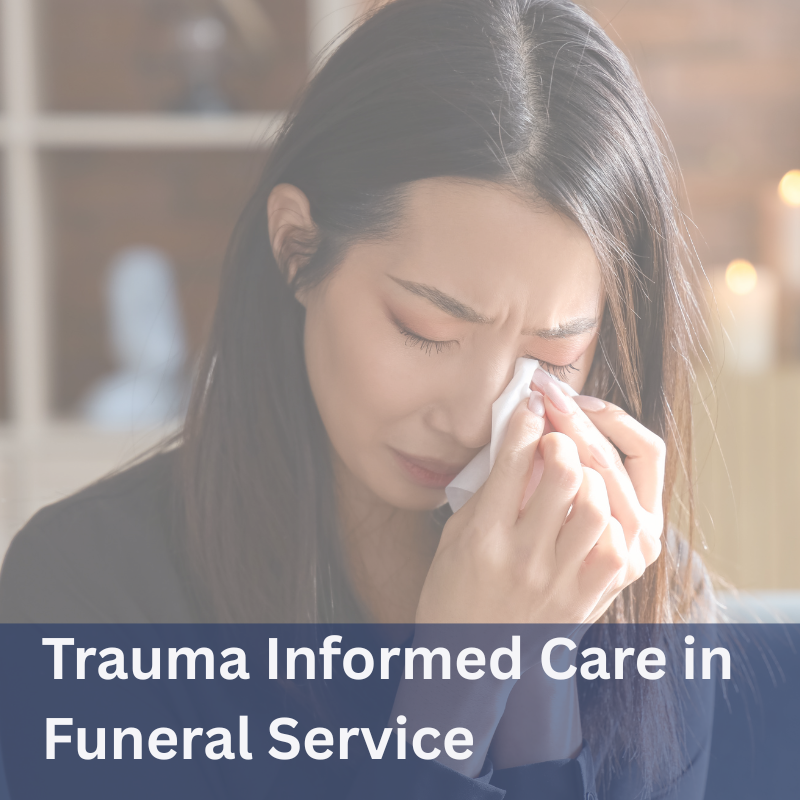
Trauma-Informed Care in Funeral Service
Wishlist Share

About Course

Funeral service professionals often work with families experiencing profound grief, sudden loss, or traumatic circumstances. Understanding the impact of trauma is essential for providing compassionate, respectful, and effective care. Trauma-informed care equips funeral directors, embalmers, and staff with the tools to recognize signs of trauma, avoid re-traumatization, and create supportive environments for grieving families.

This course introduces the principles of trauma-informed care within the context of funeral service. Participants will explore how trauma affects individuals and families, strategies for effective communication, and approaches to creating safe, compassionate interactions during arrangements, services, and follow-up care. Special attention is given to self-care for funeral professionals, who may also experience secondary trauma through their work.

By integrating trauma-informed practices, funeral service professionals can better serve families with sensitivity, strengthen trust, and uphold the highest standards of care during life’s most difficult moments.


Show More

What Will You Learn?

  • Define trauma and its impact on grieving families within the funeral service setting.
  • Recognize signs of trauma and respond in ways that promote safety, trust, and dignity.
  • Apply trauma-informed communication strategies during arrangements, services, and follow-up.
  • Implement practices that minimize the risk of re-traumatization in funeral care.
  • Develop self-care and resilience strategies to manage the effects of secondary trauma as a funeral professional.

Course Content

Course Introduction
The introduction sets the foundation by defining trauma and explaining why trauma-informed care is critical in funeral service. It emphasizes the unique role funeral professionals play in supporting families who may be experiencing grief layered with traumatic circumstances. Learning Objectives: • Understand the scope and purpose of trauma-informed care in funeral service. • Recognize how trauma differs from typical grief responses. • Establish a framework for how this course will support professional development and family care.

Module 1: Understanding Trauma in the Context of Funeral Service
This module provides a foundational understanding of trauma—its causes, manifestations, and impact on families during times of loss. It differentiates between grief and trauma, highlighting how traumatic experiences complicate the grieving process. Learning Objectives: • Define trauma and distinguish it from grief. • Identify common sources of trauma related to death and loss. • Understand how trauma can shape a family’s response to funeral service experienrence

Module 2: Recognizing Signs of Trauma in Families
Participants learn how to observe verbal and non-verbal cues of trauma in client families. The focus is on awareness, sensitivity, and early recognition to ensure the funeral home environment does not exacerbate distress. Learning Objectives: • Recognize behavioral, emotional, and physical signs of trauma. • Understand how trauma may present differently in children, adults, and diverse cultural contexts. • Develop awareness of situations that may trigger or intensify trauma during funeral arrangements or services.

Module 3: Principles of Trauma-Informed Care
This module outlines the six key principles of trauma-informed care—safety, trustworthiness, peer support, collaboration, empowerment, and cultural sensitivity—and applies them to funeral service practice. Learning Objectives: • Define and explain the six guiding principles of trauma-informed care. • Apply these principles to funeral arrangements, ceremonies, and aftercare. • Recognize how organizational policies can support trauma-informed practice.

Module 4: Communication Strategies for Trauma-Informed Practice
Effective communication is at the heart of trauma-informed care. This module provides strategies for speaking and listening with compassion, avoiding harmful language, and building trust while guiding families through decisions. Learning Objectives: • Use trauma-informed communication techniques during arrangements and services. • Demonstrate active listening and validation skills. • Avoid language or behaviors that may re-traumatize families.

Module 5: Minimizing Re-Traumatization in Funeral Care
This module explores practical steps funeral professionals can take to create safe and supportive environments, from arrangement conferences to service logistics and follow-up care. Learning Objectives: • Identify situations that may unintentionally trigger trauma. • Develop strategies to reduce re-traumatization during arrangements and funeral events. • Implement practices that prioritize family safety, dignity, and emotional well-being.

Module 6: Self-Care and Resilience for Funeral Professionals
Funeral professionals are often at risk of secondary trauma, compassion fatigue, and burnout. This module focuses on self-care practices, resilience strategies, and professional boundaries to ensure long-term well-being. Learning Objectives: • Define secondary trauma and compassion fatigue in funeral service. • Develop resilience strategies to maintain emotional health. • Create a personal self-care plan to manage stress and prevent burnout.

Module 7: Integrating Trauma-Informed Care into Funeral Service Practice
This module synthesizes course content, showing how trauma-informed care can be embedded into daily operations, policies, and team culture within the funeral home. Learning Objectives: • Develop a framework for implementing trauma-informed care organization-wide. • Collaborate with colleagues to foster a supportive workplace culture. • Commit to continuous growth and reflection in trauma-informed practice.

Course Conclusion
The conclusion reviews key concepts, reinforces the importance of trauma-informed practice, and empowers participants to carry their knowledge into compassionate, professional action. Learning Objectives: • Summarize the impact of trauma-informed care in funeral service. • Reflect on how this training enhances professional practice. • Commit to ongoing learning and implementation of trauma-informed approaches.

Earn a certificate

Add this certificate to your resume to demonstrate your skills & increase your chances of getting noticed.
selected template

Student Ratings & Reviews

No Review Yet
No Review Yet
Shopping Cart
Scroll to Top