
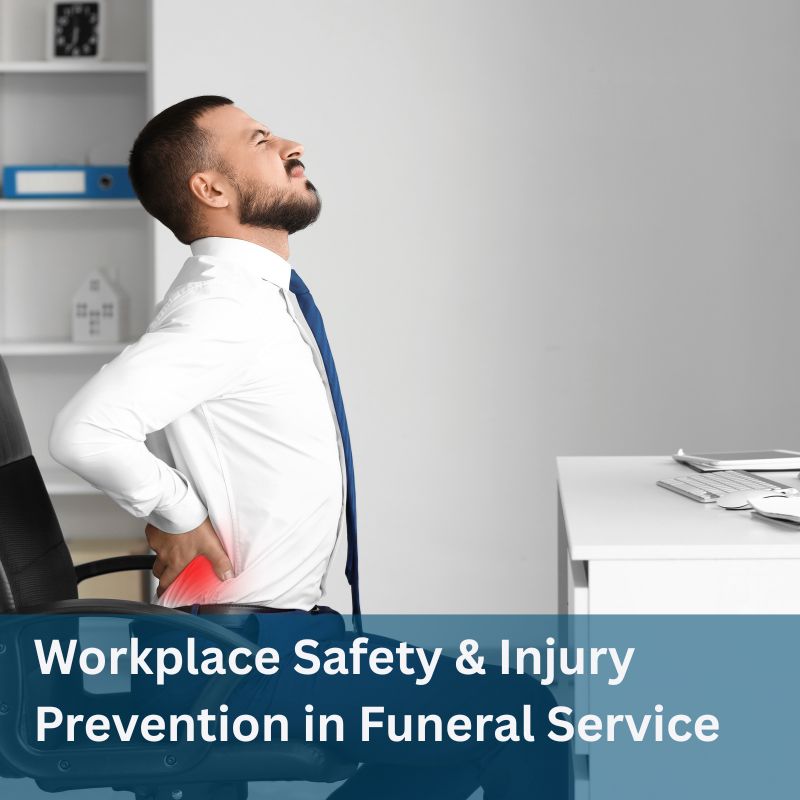
Workplace Safety & Injury Prevention in Funeral Service
Wishlist Share

About Course

Protecting Professionals. Preserving Careers. Preventing Harm.

This course provides funeral service professionals with practical, industry-specific training to identify hazards, prevent injuries, and promote a culture of safety in funeral homes, preparation rooms, removal settings, and during funeral operations. Emphasis is placed on real-world risks unique to funeral service and proactive strategies to reduce accidents, injuries, and long-term health consequences.

Upon completion of this course, learners will be able to:

  • Identify common workplace hazards specific to funeral service
  • Apply injury prevention strategies in daily operations
  • Demonstrate proper body mechanics and lifting techniques
  • Reduce risk during removals, embalming, and funeral events
  • Understand employer and employee safety responsibilities
  • Recognize early warning signs of injury and burnout

Membership Required

You must be a member to access this content.

View Membership Levels

Already a member? Log in here

Membership Required

You must be a member to access this content.

View Membership Levels

Already a member? Log in here
Show More

What Will You Learn?

  • Identify common workplace hazards specific to funeral service
  • Apply injury prevention strategies in daily operations
  • Demonstrate proper body mechanics and lifting techniques
  • Reduce risk during removals, embalming, and funeral events
  • Understand employer and employee safety responsibilities
  • Recognize early warning signs of injury and burnout

Course Content

Course Introduction
This introductory module orients learners to the purpose, scope, and structure of the course. It establishes the importance of workplace safety and injury prevention in funeral service and outlines how everyday tasks, environments, and professional expectations create unique risks. Learners will gain an overview of key themes addressed throughout the course and understand how proactive safety practices support personal well-being, team effectiveness, and long-term career sustainability.

  • Course Introduction Video
    05:32
  • Common Myths About Safety in Funeral Service

Module 1: Introduction to Workplace Safety in Funeral Service
Why Safety Matters in This Profession This module establishes the foundation for understanding workplace safety in funeral service. Learners will explore why funeral professionals face elevated risk for injury and illness, the types of hazards present in the profession, and how everyday tasks can lead to cumulative physical harm over time. • Injury and illness trends in funeral service • Physical vs. environmental vs. biological hazards • Short-term injuries vs. cumulative career damage • The cost of unsafe practices (human, legal, financial) Key takeaway: Safety is not optional—it’s professional responsibility.

Module 2: Regulatory Framework & Safety Standards
Understanding the Rules That Protect You Learners are introduced to workplace safety regulations that apply to funeral service, including the role of Occupational Safety and Health Administration. This module explains employer and employee responsibilities, required training, documentation practices, and how regulatory compliance supports safer workplaces. • Overview of Occupational Safety and Health Administration (OSHA) • Employer vs. employee responsibilities • Written safety plans and training requirements • Documentation, incident reporting, and inspections • What funeral professionals are commonly cited for Key takeaway: Compliance protects both people and businesses.

Module 3: Preparation Room Safety
The Highest-Risk Environment This module focuses on hazards commonly found in the preparation room. Learners will examine risks related to slips and falls, equipment use, sharps, ventilation, and environmental conditions, along with best practices for maintaining a safe and organized workspace. • Slips, trips, and falls • Chemical exposure and splash risks • Sharps and instrument safety • Ventilation and air quality • Electrical and equipment hazards • Housekeeping and sanitation best practices Key takeaway: Most serious injuries happen where people feel most “routine.”

Module 4: Chemical, Biological & Bloodborne Hazards
Invisible Risks with Serious Consequences Learners will explore exposure risks associated with embalming chemicals, bloodborne pathogens, and infectious materials. This module emphasizes proper use of personal protective equipment, exposure prevention strategies, and appropriate response procedures when accidents occur. • Formaldehyde and chemical exposure • Bloodborne pathogens and infectious disease risk • Proper PPE selection and use • Exposure response protocols • Decontamination and spill response Key takeaway: PPE is only effective when used correctly—every time.

Module 5: Ergonomics, Lifting & Body Mechanics
Preventing the Injuries That End Careers This module addresses one of the leading causes of injury in funeral service: musculoskeletal strain. Learners will review proper lifting techniques, ergonomic principles, use of mechanical aids, and strategies to reduce long-term damage to the spine, joints, and muscles. • Common musculoskeletal injuries in funeral service • Proper lifting and carrying techniques • Team lifts vs. mechanical assistance • Stretcher, cot, and removal device safety • Long-term spinal health and injury prevention Key takeaway: Most injuries are preventable with proper technique and planning.

Module 6: Removal & Transport Safety
Risk Beyond the Funeral Home Focusing on first-call and transport situations, this module examines hazards encountered during removals in homes, hospitals, and public settings. Learners will consider environmental risks, teamwork, equipment use, and planning strategies that reduce injury during complex removals. • Residential, hospital, hospice, and scene removals • Stairways, tight spaces, and uneven surfaces • Vehicle loading and unloading • Traffic, weather, and night-time risks • Scene awareness and situational judgment Key takeaway: No two removals are the same—plan before you move.

Module 7: Funeral Services, Visitations & Cemetery Operations
Safety During Public-Facing Events This module explores safety concerns during public-facing events, including crowd management, weather conditions, cemetery hazards, and vehicle-related risks. Learners will assess how safety planning protects both staff and the families they serve. • Crowd management and trip hazards • Inclement weather considerations • Cemetery and graveside risks • Vehicle processions and traffic safety • ADA and accessibility considerations Key takeaway: Public events introduce unpredictable hazards.

Module 8: Stress, Fatigue & Human Factors
When the Biggest Risk Is the Person Learners will examine how fatigue, stress, and emotional demands influence judgment and increase the likelihood of accidents. This module highlights the connection between mental well-being and physical safety in funeral service settings. • Fatigue, long hours, and on-call work • Stress and decision-making errors • Burnout and injury correlation • Substance use risks in safety-sensitive roles • Recognizing when to slow down Key takeaway: Mental fatigue creates physical danger.

Module 9: Incident Response & Injury Management
What to Do When Something Goes Wrong This module outlines appropriate actions when injuries or near-misses occur. Learners will review reporting procedures, documentation, workers’ compensation basics, and how incident analysis can lead to improved safety practices. • Immediate response to workplace injuries • First aid basics and emergency procedures • Reporting injuries and near-misses • Workers’ compensation basics • Learning from incidents instead of hiding them Key takeaway: How you respond matters as much as prevention.

Module 10: Building a Culture of Safety
Making Safety the Standard The final module focuses on long-term improvement through leadership, accountability, and shared responsibility. Learners will explore how safety culture is built, maintained, and reinforced through everyday decisions and professional standards. • Leadership’s role in safety culture • Training, refreshers, and accountability • Encouraging reporting without fear • Safety checklists and daily habits • Continuous improvement in funeral service workplaces Key takeaway: Safe workplaces are built intentionally—not accidentally.

Course Conclusion
Protecting Your Most Valuable Asset: Yourself This concluding module reinforces the key principles of workplace safety and injury prevention covered throughout the course and emphasizes the importance of applying them in daily funeral service practice. Learners are guided to reflect on personal habits, identify actionable changes, and commit to safer professional behaviors that support long-term health, career sustainability, and a culture of safety. The focus of this module is not new content, but intentional integration—turning knowledge into consistent, professional action. • Safety as a professional ethic • Longevity in funeral service careers • Turning awareness into daily practice • Final reflection and commitment to safety

Earn a certificate

Add this certificate to your resume to demonstrate your skills & increase your chances of getting noticed.

selected template

Student Ratings & Reviews

No Review Yet
No Review Yet
Shopping Cart
Scroll to Top